
Industry Technology
What Is OOH Advertising Management Software? A Guide for Media Owners
Discover how dedicated OOH advertising management software unifies static billboard charting, DOOH scheduling, proof of performance, and landlord lease administration in a single platform.
By Ad Manager Connect Team · · 5 min read

Why OOH Operations Need Purpose-Built Software
Out-of-home (OOH) media operations involve operational complexities that standard commercial business systems cannot handle. Unlike digital web advertising or broadcasting, OOH media owners manage physical structures anchored to specific geographic points, subject to local regulatory restrictions, landlord revenue-sharing agreements, physical posting schedules, and mechanical hardware loops. Relying on generic CRM platforms, spreadsheets, or disconnected point solutions creates administrative bottlenecks that limit growth and introduce costly human error. OOH advertising management software is a specialized enterprise platform built specifically to run the end-to-end commercial, operational, and financial workflows of an out-of-home media enterprise. By consolidating inventory control, proposal generation, charting, traffic management, proof of performance, and landlord lease accounting into a single operational hub, these systems allow plant owners and media sales teams to maximize asset yield while maintaining total control over their physical and digital networks.
Core Capabilities of OOH Advertising Management Software
At its foundation, OOH advertising management software replaces fragmented legacy systems with a single source of truth for every frame, panel, and screen in a media owner's portfolio. The software maintains granular metadata for every asset, including exact latitude and longitude, structure type, illumination, facing direction, read type, and illuminated operating hours. This central database acts as the foundation for all sales charting, operations, and financial auditing.
Crucially, modern management platforms bridge the gap between traditional static inventory and digital out-of-home (DOOH) networks. While static billboards operate on traditional two-week or four-week posting cycles, digital displays allocate inventory by share of voice (SOV), spot length, loop duration, and target impression thresholds. Dedicated software handles these distinct inventory models simultaneously within the same master booking grid, preventing double-bookings across hybrid networks.
- Real-time inventory availability across static paper, vinyl, and digital screens
- Automated mapping and interactive proposal generation for sales teams
- Enforcement of line-of-sight brand exclusions and competitive separation rules
- Work order creation for posting crews, copy tracking, and vinyl logistics
- Photographic proof of performance (PoP) gathering and campaign verification
- Landlord lease administration, fixed rent schedules, and percentage yield calculations
How OOH Advertising Management Software Streamlines Sales and Charting
In a traditional OOH sales environment, checking availability for a complex multi-market proposal requires back-and-forth communication between account executives and traffic managers. By the time availability is verified manually, high-demand inventory may already have been offered to another agency. Specialized software solves this by presenting live, accurate availability directly within the proposal generation workflow.
When building a campaign chart, the software automatically evaluates real-time inventory against complex business logic. It checks for physical availability, accounts for hold periods, and enforces strict line-of-sight competitive exclusions—such as preventing competing fast-food brands or alcohol advertisers from booking adjacent faces or sharing the same digital loop. Once the client approves the proposal, the system automatically converts held inventory into confirmed bookings, instantly locking out conflicting requests across the network.
Operational Workflows: From Posting Instructions to Proof of Performance
Securing a campaign booking is only the first step. The operational strength of OOH advertising management software lies in its execution workflows. For static plant assets, the system generates detailed posting work orders grouped logically by geographic route, posting cycle, and creative asset version. It tracks vinyl delivery dates, substrate specifications, and warehouse stock levels to ensure installation crews have the correct materials before riding out to site locations.
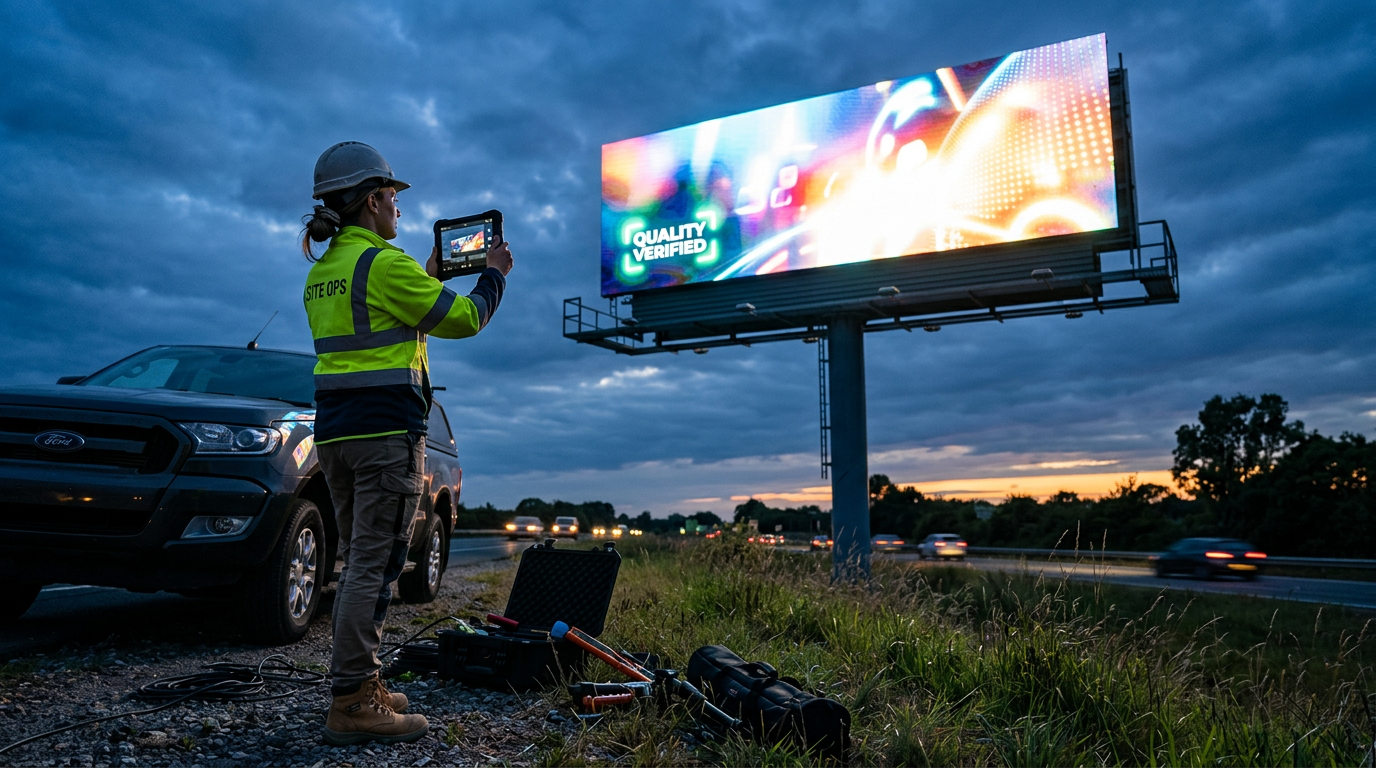
Once posting is complete, field crews upload time-stamped, geotagged photographs directly into the system through field operations tools. The platform automatically associates these photographs with the corresponding campaign contract line item, generating clean, professional proof of performance (PoP) reports. By automating PoP generation, media owners eliminate client payment disputes, accelerate cash collection, and protect contractual revenue.
DOOH Scheduling and Dynamic Loop Control
Managing digital out-of-home inventory introduces layers of operational friction that static workflows cannot address. Rather than selling physical space exclusively to one brand for a month, DOOH splits screen capacity into time slots, loops, and impression packages. Purpose-built management software acts as the central engine that orchestrates campaign scheduling across DOOH networks and diverse content management systems (CMS) and media players.
Instead of manually logging into multiple third-party player software packages to schedule creative files, operations teams manage scheduling directly within the core advertising software. The platform translates commercial contracts into automated player instructions, balancing spot frequency, dayparting restrictions, and programmatic fill allocations. This automation eliminates manual entry errors, ensures full delivery of contracted impressions, and prevents accidental over-saturation of single spots.
Financial Management: Revenue Recognition and Landlord Accounting
The financial engine of an OOH media business operates under rules distinct from traditional media channels. Revenue must often be recognized across non-calendar posting cycles, while billing structures can vary between prepay, monthly in advance, or post-campaign execution. Dedicated software aligns financial billing runs with actual posting dates, ensuring revenue recognition aligns perfectly with campaign execution.
Furthermore, landlord lease management represents one of the largest operational costs for plant operators. OOH management software maintains historical lease agreements, calculating complex payout structures including flat monthly rent, minimum guarantees, straight percentage of net or gross revenue, and tiered performance thresholds. Automating landlord payouts drastically reduces finance overhead and maintains transparent relationships with property owners.
Selecting the Right Software for Your Media Enterprise
When evaluating OOH advertising management software, media owners should look beyond basic booking calendars. The platform must demonstrate deep domain engineering capable of scaling alongside your plant—whether managing 50 premium static billboards, hundreds of transit-adjacent panels, or nationwide digital networks.
Choosing a system developed by industry veterans ensures your software vendor understands the practical realities of posting delays, local authority restrictions, and complex agency billing requirements. The ultimate goal of adopting specialized software is to transform manual operational overhead into scalable commercial capability, allowing your operations team to manage more inventory with greater precision and higher profitability.
Ad Manager Connect, built by Dot2Dot Communications, follows this purpose-built approach. It unifies campaign management, visual charting, proposal and contract generation, field operations with mobile proof of performance, accounting including landlord lease management, and reporting dashboards in a single platform designed for OOH media owners, billboard operators, and DOOH networks. You can explore how the modules connect on the platform overview.
See It Running on Your Own Inventory
The fastest way to judge whether a platform fits your operation is to see it working against your own inventory, posting cycles, and lease structures. Book a demo to walk through the workflows that match how your OOH or DOOH business actually runs, or contact the team with questions about your network.
See Ad Manager Connect on your inventory
We will walk through the platform using workflows that match how your OOH or DOOH business actually runs.