
Industry Technology
AI and OOH: Why Human Oversight Still Matters
Artificial intelligence offers powerful automation for OOH and DOOH networks, but complex inventory schedules and strategic client relationships still require grounded human judgment.
By Ad Manager Connect Team · · 8 min read
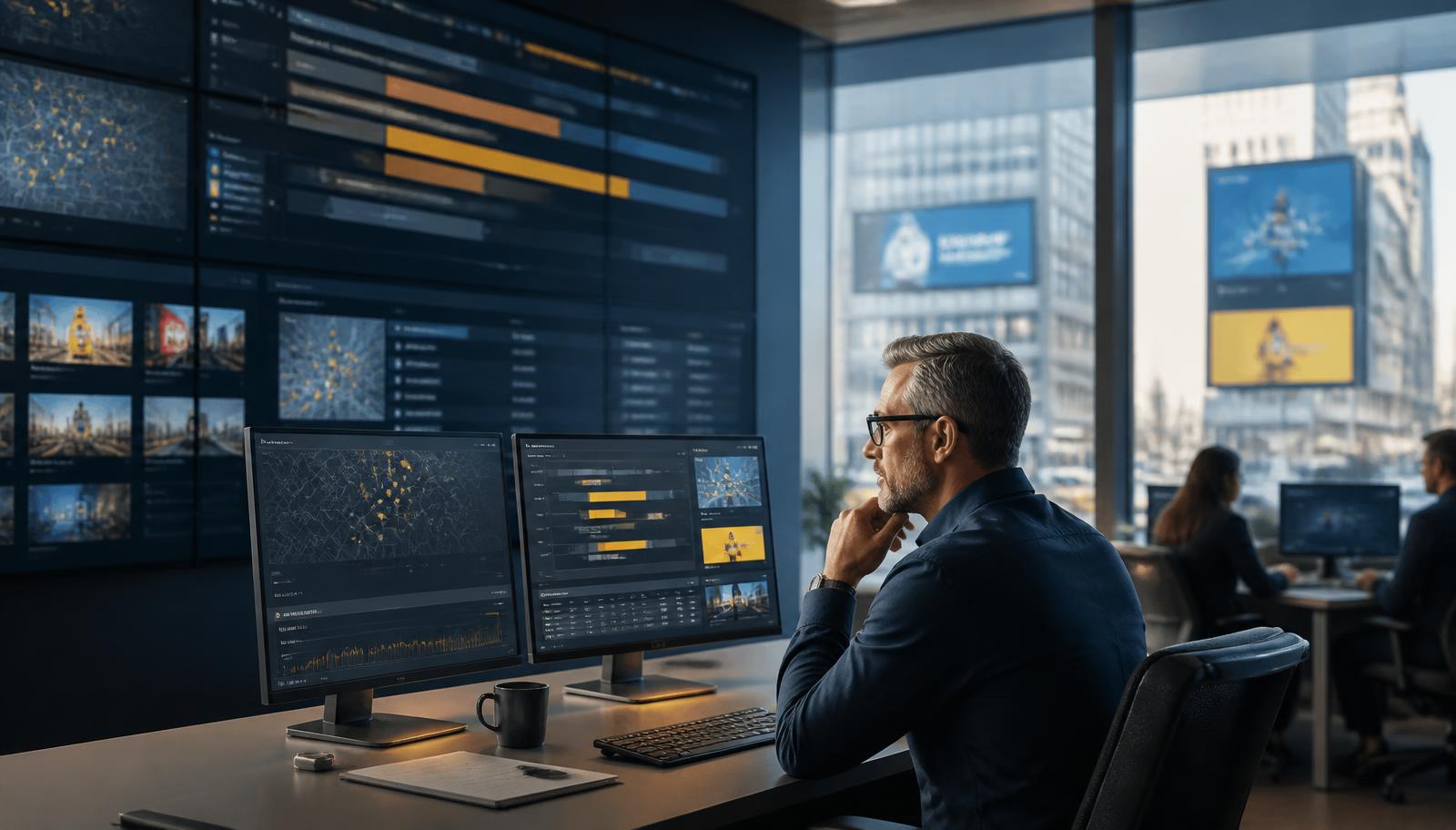
Balancing Artificial Intelligence and Operational Oversight in OOH
The Out-of-Home (OOH) and Digital Out-of-Home (DOOH) industry has seen an incredible shift in how business is conducted over the past several decades. Traditional paper and painted billboards have evolved into digital displays, centralized inventory and scheduling systems, programmatic buying, audience measurement and increasingly sophisticated tools for managing media campaigns.
Artificial Intelligence (AI) represents another potential step in that evolution.
While AI is still relatively new to many OOH and DOOH operators, there is considerable interest in what it could eventually do. AI can process enormous amounts of information, identify patterns, automate repetitive work and help people make better decisions. As the technology develops, it is reasonable to ask how much of an OOH operation could eventually be automated.
But there is an important distinction between using AI to help run a business and allowing AI to run the business on its own.
For OOH operators, that distinction matters.
AI Is Powerful—but Long-Term Operations Are Complicated
A recent computer science research paper, CivBench: A Long-Horizon Benchmark for Tool-Mediated Agents in Civilization VI, provides an interesting illustration of some of the challenges involved in giving AI agents responsibility for complex, long-running tasks.
The researchers tested AI agents in Civilization VI, a strategy game that requires hundreds of decisions managing multiple victory conditions over an extended period. The benchmark was designed to examine how well AI agents monitor changing conditions, maintain a strategy and follow through on decisions over many turns.
The study identified two particularly interesting patterns.
First, AI agents don't always monitor everything they should. Even when important information was available, agents sometimes failed to proactively check it unless they were specifically prompted to do so.
Second, there can be a gap between planning and execution. Agents sometimes developed a strategy during planning but failed to consistently carry out the commitments they had made as the game progressed.
It is important to put the research into perspective. Running a strategy game is obviously very different from operating an OOH media business. The study does not prove that AI will make the same mistakes in an OOH environment. What it does illustrate is that long-running autonomous systems can have difficulty maintaining awareness of important information and consistently following through on their own plans.
Those are useful considerations for any business looking at increasingly autonomous AI, and they are particularly relevant to OOH.
The OOH Business Is Full of Context
An OOH media operation isn't simply a collection of available advertising faces waiting to be filled. There are contracts, client commitments, property-owner agreements, campaign objectives, inventory values, competitive considerations, creative requirements, regulatory restrictions, makegoods, maintenance schedules and countless other factors that can affect what appears to be a straightforward decision.
Consider what happens when an operator is approaching full occupancy.
Imagine that one face is booked from January 1 through January 28. The next available period begins January 29, and a new campaign being scheduled by the system begins February 5.
If AI selects that face for the February 5 campaign, it may appear to have made a perfectly reasonable decision: the face is available, the campaign has been accommodated and the inventory is generating revenue.
But the booking has potentially created an unsellable gap from January 29 through February 4.
A different face might have been available for the February 5 campaign without creating that gap, allowing the first face to remain available for a short-term booking or contract extension during the intervening week. An experienced operator looking at a visual charting interface can often spot this kind of opportunity immediately.
The challenge becomes even more complicated when deciding which faces to use when only a limited amount of premium inventory remains.
An AI system may choose the highest-value boards because the immediate objective is to maximize revenue or utilization. But what if the company's best customer is about to request those same boards? The top account executive may already be on the phone with that client, negotiating a much larger campaign that the system doesn't know is coming.
If those premium locations have already been committed to another campaign, the customer may not accept the remaining, less desirable inventory. The operator could end up with a collection of difficult-to-sell faces while having successfully optimized the current booking.
The result could be lower overall revenue despite having made an apparently optimal decision.
This is an important distinction between optimization and business judgment.
An AI system can optimize against the information and objectives it has been given. But it may not know that a major customer is considering a new campaign, that a sales executive is actively negotiating a deal, or that preserving a particular combination of faces for another few days could ultimately produce a much more valuable booking.
The most profitable decision isn't always the one that maximizes today's utilization.
The Human Factor Starts Before the AI Does
There is another consideration that is easy to overlook when discussing AI automation: who built the system in the first place?
An AI agent responsible for running an entire organization can only operate within the framework it has been given.
Developers and business analysts decide what information the system can access, what conditions it should consider, which objectives it should prioritize, what exceptions it should recognize and what actions it is allowed to take.
If they understand the business exceptionally well, they can build a system that accounts for a remarkable number of variables.
But no development team knows everything.
An OOH business can contain years of accumulated knowledge that may not exist in a database or formal business rule. Experienced salespeople and operations managers often understand relationships between customers, inventory, timing and market conditions that have developed over years of doing business.
A developer may not know that a particular combination of faces is normally held for a specific type of customer. They may not recognize that a seemingly minor scheduling decision can make an entire block of inventory harder to sell. Or they may not anticipate the way several relatively small events interact to create a much larger commercial impact.
If one of those conditions is missed when the AI system is designed, it doesn't simply remain an occasional human oversight.
It can become part of the system itself.
That is one of the fundamental challenges of highly autonomous AI: the system can be extremely effective at following the rules and objectives it has been given while still producing the wrong business outcome because an important piece of business context was never included.
This doesn't make AI development a bad idea. It makes business expertise an essential part of AI development.
The people designing and implementing these systems need to understand not only the technology, but also how an OOH business actually operates.
The Answer Isn't Less Automation. It's Better Automation.
None of this means OOH operators should avoid AI. Quite the opposite.
There is enormous opportunity to use AI and automation to remove repetitive work and give operations teams better information.
The industry doesn't need to wait for AI to start benefiting from automation. A number of OOH and DOOH management systems already automate portions of these workflows, including inventory management, scheduling, campaign delivery, billing, reporting and operational monitoring.
Modern systems are also increasingly being designed with structured data and workflows that make it easier for AI to find, interpret and act on information within the system.
That means the future may not be about replacing existing software with AI. In many cases, it will be about adding AI capabilities to systems that already provide the operational foundation.
AI can help with tasks such as: • Checking creative files against technical specifications • Identifying scheduling conflicts • Analyzing inventory utilization • Forecasting demand • Generating reports • Monitoring campaign delivery • Identifying unusual patterns or potential problems • Automating routine administrative processes • Bringing together information from multiple systems • Extracting information from existing records and turning it into actionable recommendations
Many of these functions can already be supported through established OOH management platforms. The opportunity with AI is to make those systems even more useful by allowing people to ask questions of their operational data, identify potential issues sooner and automate appropriate actions.
For example, platforms such as Ad Manager Connect are designed around the operational data and workflows of OOH businesses, bringing together areas such as campaign management, proposals and contracts, inventory, scheduling, billing and reporting. Building AI capabilities on top of that structured operational foundation can be considerably more useful than asking an AI system to operate with incomplete or disconnected information.
The key question isn't whether AI should be involved.
It is where AI should make the decision, where it should make a recommendation, and where a person should remain responsible for the final decision.
Human-in-the-Loop Is a Practical Model for OOH
One of the most practical approaches is a Human-in-the-Loop model. Rather than asking AI to make every decision, technology handles the volume and complexity while experienced people remain responsible for important exceptions and business decisions.
Think of it as a series of gates.
Automation handles the routine.
The system can process thousands of records, identify conflicts, monitor campaign performance and flag anything that falls outside expected parameters.
For example, software can automatically check campaign flight dates, creative specifications and delivery status. It can identify potential inventory gaps, double-bookings or scheduling conflicts. It can generate billing and proof-of-performance reports and automate other routine administrative tasks.
People handle the exceptions.
When something unusual happens, an experienced operator can review the situation, consider the broader context and decide what should happen next.
That might mean approving a custom rate, protecting premium inventory for a key account, deciding whether to hold a particular face for an expected campaign or overriding an automated scheduling recommendation.
This doesn't eliminate automation. It makes automation more useful.
Instead of having an operations team spend its day checking every routine transaction, technology can bring the issues that actually require attention to the surface.
That can allow a relatively lean team to manage a much larger and more sophisticated media operation without sacrificing the judgment that comes from understanding the business.
The Future Is Automated—and Still Human
The OOH and DOOH industry has never been afraid of technology.
Every major technology shift—from digital displays to centralized scheduling to programmatic buying—has changed the way operators work. AI will likely be no different.
The opportunity isn't to choose between humans and AI. It is to determine which decisions are best handled by technology and which decisions benefit from experience, judgment and context.
The most effective OOH businesses will likely be the ones that get that balance right.
Use AI to process more information. Automate the repetitive work. Identify opportunities and problems faster. Give sales and operations teams better tools and better visibility.
But when a decision has significant commercial, contractual or strategic consequences, having an experienced person in the loop isn't a weakness in the system.
It's part of the system.
The goal isn't an OOH operation with no people involved.
The goal is an OOH operation where technology allows people to spend less time managing routine tasks—and more time managing the business.
If you're interested in seeing how a purpose-built OOH management platform can provide the operational foundation for greater automation, reach out for an Ad Manager Connect demo today.
See Ad Manager Connect on your inventory
We will walk through the platform using workflows that match how your OOH or DOOH business actually runs.